I tend to try and pass myself off as a Northerner when I can get away with it - I was born in Sheffield, which counts, but I moved away before I turned two, so my claim is quite flimsy. If you hear my voice you’d have trouble placing me - I tend to have no regional accent most of the time, but sometimes something creeps in. I speak almost like a Londoner. I must quickly add, though, that by Londoner, I mean Cockney. I wasn’t born in London, but my mum was, and her and my dad lived there for a time. London, specifically the east end, is a place I grew up knowing as a pseudo homeland - I also see Wales as a pseudo homeland, Sheffield too; places connected to my parent’s lives that I get a sense of familial identity and heritage from.
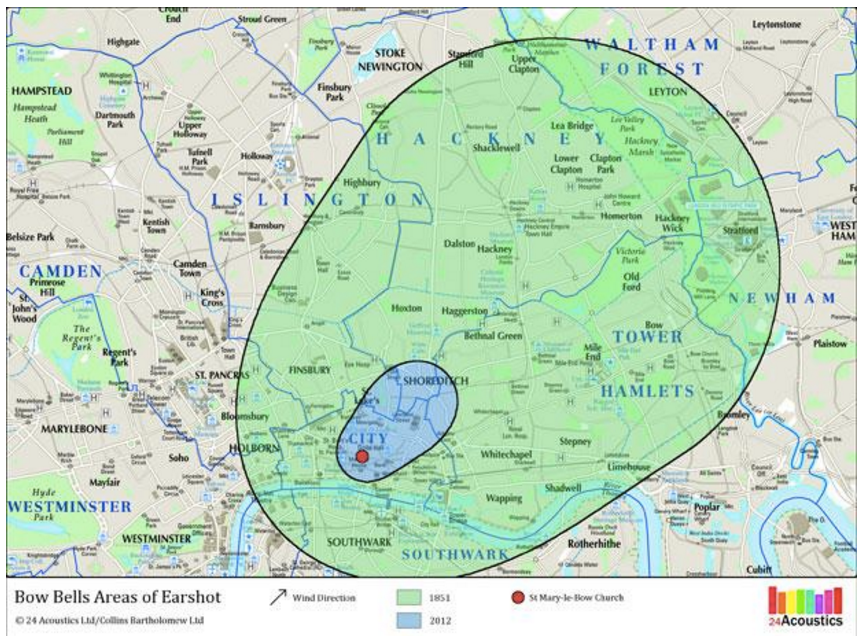
Cockney is what is called a ‘demonym’, an identity tied to a place. It is an accent, a dialect and, vanishingly, a culture. What makes one person a Cockney and another not, has been used to denote both ‘true Londoners’ and Cockneys over many years. To be born a Cockney, you must be born within earshot of Bow Bells. An old and historied church, St. Mary-le-Bow, still stands today, in the 1800’s it’s bells could be heard from as far as Leyton, Stratford, and Bromley in the city of London. But today, according to a 2012 Study; it only get’s as far as Shoreditch:
Cockney is better known for Cockney Rhyming Slang - but it also has an interesting and jumbled dialect that combines Yiddish and Romani words. Any one who has watched Only Fools and Horses may be familiar with these, such as ‘Cushty’, ‘Shtum” and ’Wonga’. If you look at the Wikipedia page for Cockney Rhyming slang, there is a fun triple rhyme for ‘arse’ - it started with ‘bottle’ (bottle and glass - arse) then ‘Aristotle’ (Aristotle - bottle) which would be shortened to ‘Aris’, and became ‘plaster’ (plaster of paris - Aris). Madness. I love it.
I was also excited to learn the origin of some Britishisms; such as ‘to blow a raspberry’ originating from raspberry tart - fart or ‘taking the Mick/Mickey’ from Mickey Bliss - taking the piss. In fact ‘take the piss’ has it’s own interesting origins. Then there’s ‘berk’, which comes from the famous fox hunt, Berkley Hunt, to rhyme with, well - you can take a guess at that one…
Now, I am a mockney - my family come from the Cockney diaspora, I am a fraud. But, for this post, I’d like to share something that, although considered ‘Cockney’, is enjoyed across all of London and Essex. I would like to introduce you to Pie and Mash:
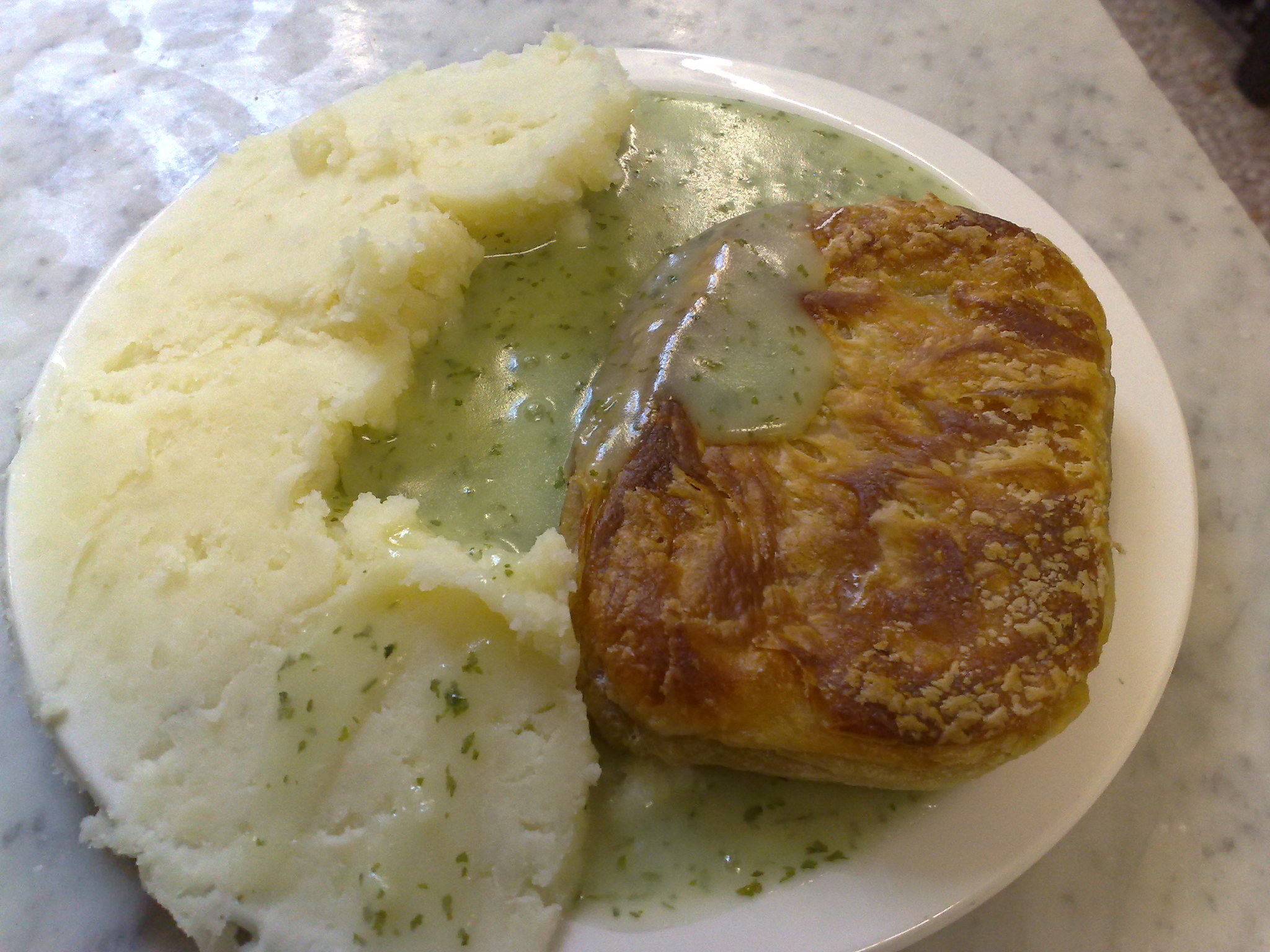
Now, before you look at me strangely - yes I can see what it looks like, and this is something I absolutely love about Pie and Mash, it is categorically impossible to photograph the dish well. Nowhere online, in the real or even in rumors have I seen a good photo of Pie and Mash. This isn’t a hugely important thing to the dish itself, but I love it’s consistency in remaining unappealing.
So what is it? Minced beef pie in shortcrust pastry, mashed potato, liquor (a parsley sauce made with fish stock), and malt vinegar. Because this originated in the docks of London, it can also be an eel pie, but you’d be hard pressed to find anyone to prefer an eel pie over minced beef these days. What seperates Pie and Mash from simply being a pie and some mash is the vinegar and liquor, it doesn’t make the dish particularly exotic, or wild, its a rather small difference - but to be fair, it is just called ‘pie and mash’ so it’s not like yoiu’d expect something that different.
I love Pie and Mash, it’s comfort food, it’s a meal I always enjoy, it reminds me of family, my late uncle, the stories I was told in my youth, and my working class roots. I can’t give much of a passioned call to try it, it is simple working class food that could easily be dismissed, it doesn’t hold the cultural cache of Cornish Pasties, the Bakewell tart or a Gregg’s sausage roll, but it has importance to me. If you feel like trying it, there’s not too many places serving it, let alone good ones; so if you want to try it at home make sure to use a recipe that uses fish stock for the liquor and shortcrust for the pastry.
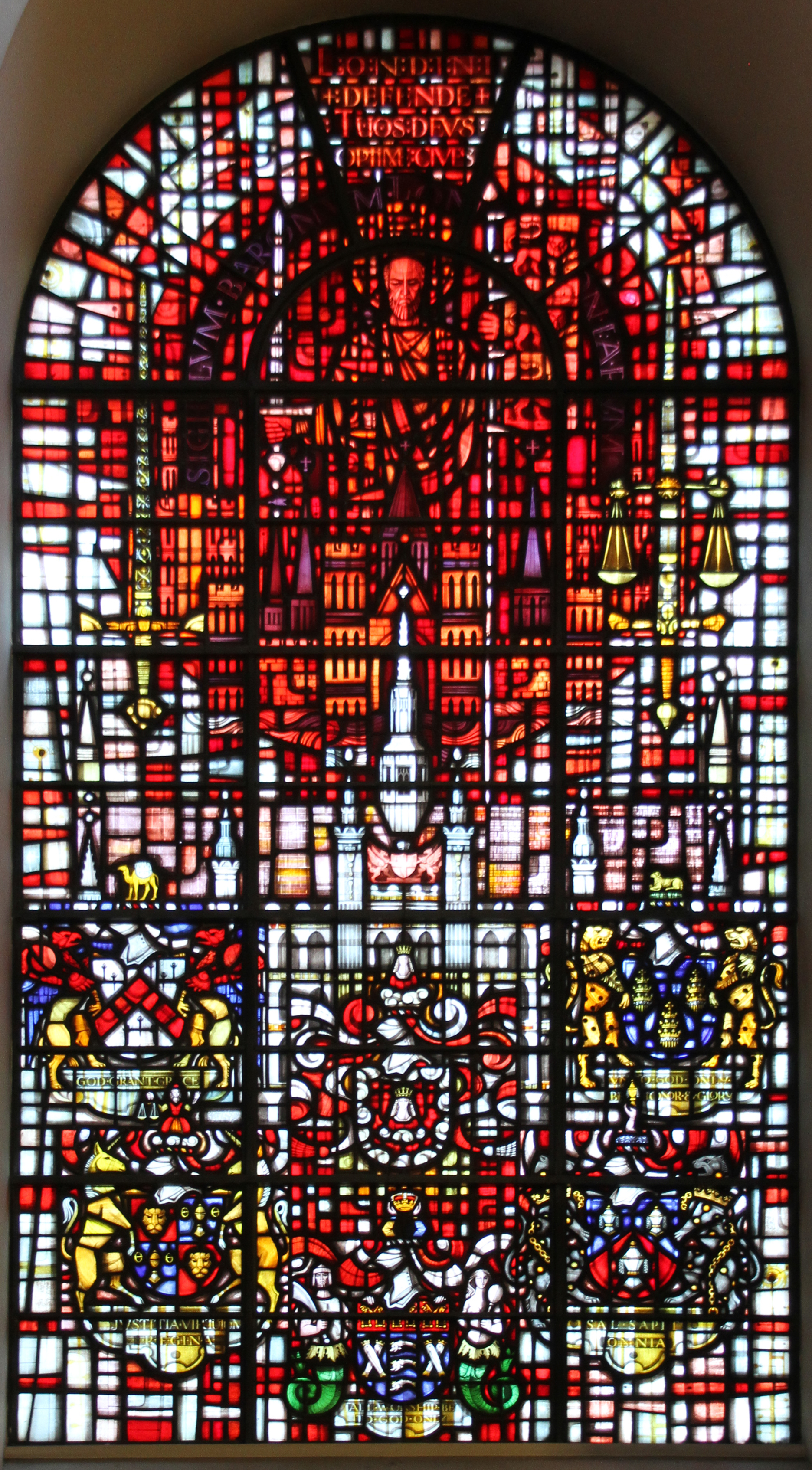
To cap off, here is the beautiful stained glass window from St. Mary-le-Bow by Tony Hisgett: