If you’re a totally cool person, you’ve probably loaded up DOOM or DOOM 2 at least once in your life - and you may remember, ther’s some gameplay footage playing behind the game’s menu, showcasing the gameplay*. This is generally referred to as a ‘demo’ and most id tech games had one. You may have guessed from DOOM’s rather small size that this ‘demo’ wasn’t a video file, in fact what was ‘playing’ was a recording of John Romero playing the game. Now, you might hear this and think, “oh, okay - that’s cool I guess,” - and yes that’s how I reacted when I heard, but I think how this works is actually quite interesting.
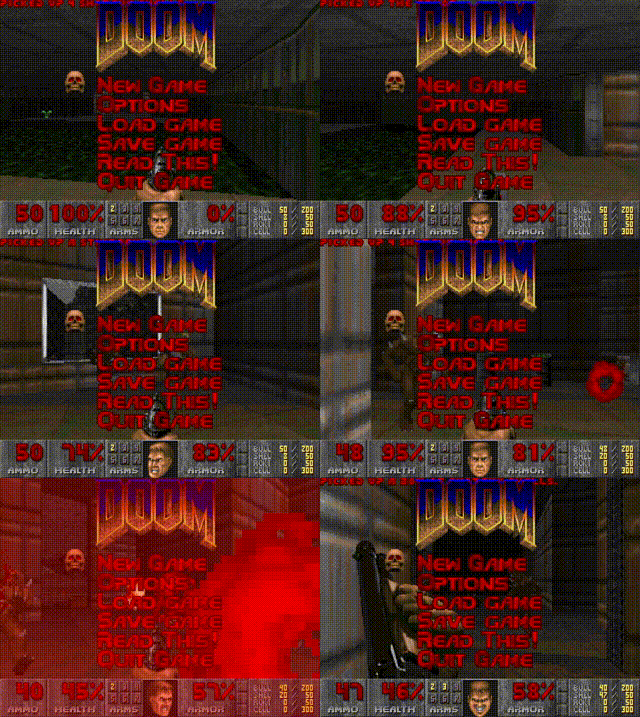
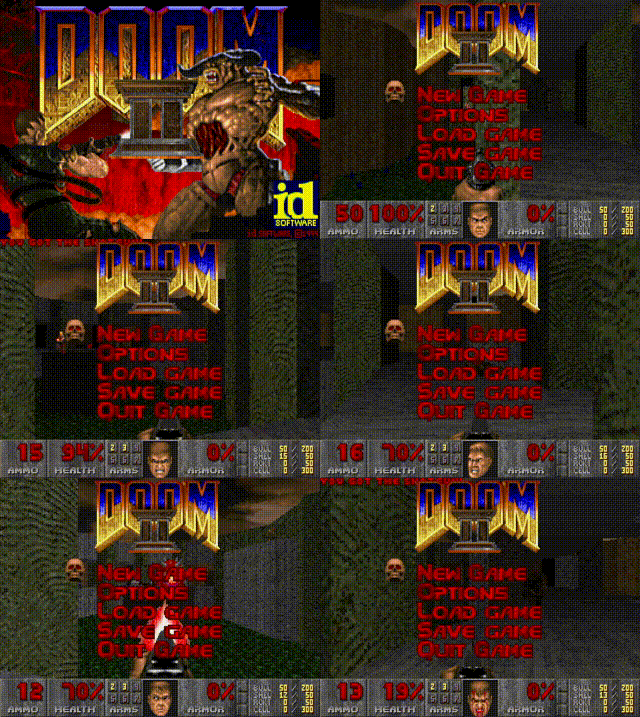
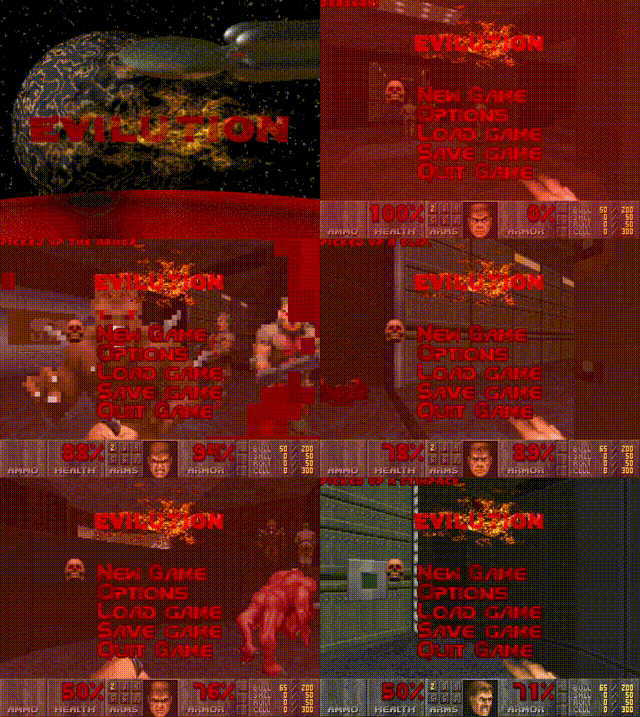
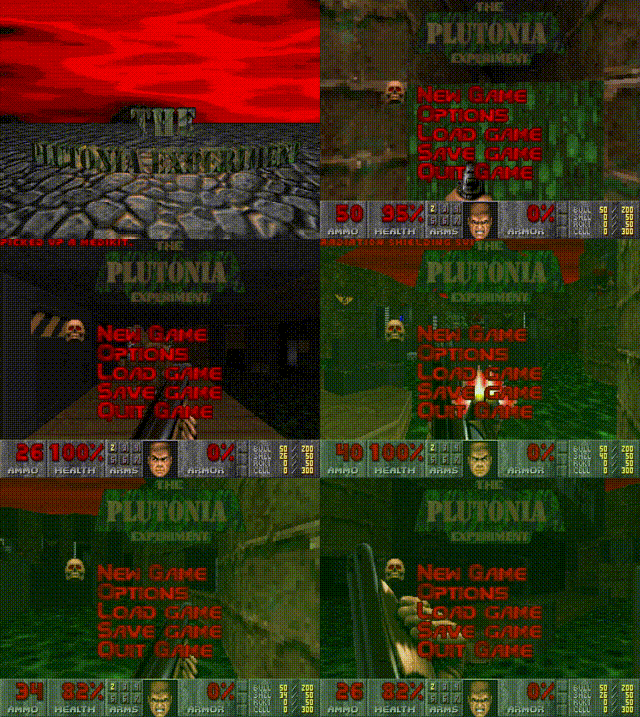
My initial assumption was that these recordings were created like one particular boss in Super Meat Boy, which was the first instance of this sort of thing that I heard about. In one level, Brownie is a boss that behaves exactly like Super Meat Boy and is simply the recorded run of developer Edmund McMillan completing the level, your goal is just to beat him, you don’t interact with him, he is simply a series of inputs that completes the level.
But, on reflection, DOOM couldn’t work like that, could it? There’s enemies, they interact with the world, navigating and attacking, their actions informed by reaction and RNG - there’s just no accounting for the random decision making of the AI, and both your damage and the monsters are effected by RNG. You can’t only record the player - surely you’d have to record everything?
But here’s the interesting part: it’s not actually RNG, at least not in the literal sense. RNG stands for ‘Random Number Generator’ - the general understanding peopl have is that the game just randomly decides something, and although the deck may be stacked this way or t’other, it’s basically a dice roll that happens under the hood.
Now, what the DOOM engine does, is make a call to an array every time it needs a ‘random’ number, incrementing the index each call. To break that down, the engine has a list of numbers (stored in an array), and when, for example, an Imp tries to kill the player it asks for a number from the ‘random’ list, it’s given one and depending on what it is, they either shoot a fireball or try getting closer first. Then, immediately after, another Imp is making its own decision about what to do. But when they ask, the index has increased by one, moving to the next number in the array, this number might result in the same Imp behaviour, or something different.
Now if that makes sense, I want you to expand that to everything that has any random variation. Everything. Shotgun spread patterns, damage, every bit of the monsters’ behaviour - all asking the list of numbers for a value that determines their behaviour, one after the other, each and every time the index goes up by one until the list ends and it starts back at the first value again. When a level starts, the list of numbers starts at index 0 (this is the first number, arrays are just like that), the only thing that changes what asks the list for a number and for what, is the player! The list does not change, so if the player does the exact same thing at the exact same time, the game will always play out the same way!. So it actually is like Brownie from Super Meat Boy - all you need is to have a script of player inputs and - bam! A perfect in-engine replay. Even the sounds match up. the plasma rifle makes calls to this array to determine the change in pitch of each shot - so when you replay a demo, it maintains everything!
What’s also cool about this is you can make your own. Just start DOOM with ‘-record <filename>’ in DoS - and you’re recording, and the engine can just as simply play it back with ‘-playdemo <filename>’! Since the engine’s just reading keyboard and mouse input, the files (which were called lumps**) were far smaller than a direct video recording, but infinitely better in quality, as the replay is a complete recreation of the game during the recording.
When I found out about this, something that had puzzled me about another game suddenly made sense. In Halo 3 there was a ‘Theatre Mode’ where you could save game sessions (either multiplayer or campaign level) then replay them with an unlocked free camera - you basically had a Braindance. You could then record clips from any players’ perspective, or as a camera moving freely as the game replayed around you. What confused me, was that if I recorded a short video the file size was huge compared to the full recording - which now makes total sense, it was all just player inputs!
Back in the 1990s, the small file size meant that it was even possible to send people your DOOM runs - if you got an insane speedrun time, you could prove it to your friends across the globe with a file leagues smaller, and infinitely higher in quality. Today, we’re spoiled by video, and video hosting. You can simply sign up to YouTube and upload a video in minutes et viola - now it’s available to anyone to watch, and hosted for free. It’s also easy to record videos of our computer screen, we’re far beyond even the days of HyperCam, Fraps, and Bandicam, let alone before them. Back then DOOM lumps were the only way to share your gameplay with someone else. Well, almost.
The Let’s Play is something that is often seen as a child of YouTube, and the era of widespread access to online video. However, it existed long before in forum posts, blogs, and usenet groups. Of course what I am talking about is the written Let’s Play, or the screenshot play along, or any number of variations. It’s generally agreed that the Let’s Play started, as many things do, on the Something Awful forums - but all we know is that a user created a post with a screenshot playthrough of The Oregon Trail in 2005, and the thread has long since been deleted.
But it is 2026 now, and the idea of creating a written Let’s Play seems a bit needlessly archaic, and esoteric. The expected format is video, and even strategy guides and walkthroughs are predominantly video now - of course GameFAQs holds on, but I worry the writing is on the wall. In many cases video is a better representation of the game, it technically falls short of a ‘demo’, but it’s the closest you can get. Not to mention the connection between audience and writer can be stronger in video, you might even see their face, and they can joke and react in real-time; and, hey, let’s face it - liking video games and wanting to share that doesn’t mean that you are a good writer. Many written Let’s Plays were full of gamerisms the likes you would expect in early 2000’s GameFAQ guides written poorly by edgy 13 year olds.
That said, I think there’s an essence of deliberation and reflection in written Let’s Plays that you don’t get in their modern incarnation. You have to think, put words to a page and communicate something far more than if you just sit in front of a camera to scream at Freddy Fazbear. You also don’t substitute a playthrough so your audience doesn’t feel like trying the game themselves***. I think a written let’s play is a more intimate way of sharing, in a video there is a concrete, strong translation of the game through the bits and bytes of video; but in writing the Let’s Player has to translate their experience, they have to actively convey something. It’s the difference between sharing the beauty of a landscape with a photo, and sharing it with a painting****.
I have more that I want to say regarding media-about-media of the internet in general, but for this post I’ll leave it at that. Originally this was going to be the opener to my own written Let’s Play - but I haven’t got around to playing the game I was planning on writing about, so - uh, maybe next time?
Until then, I hope this was at least a little interesting, and thank you for reading.
*These don’t appear when using a source port like GZDoom, so you may have not seen this if you never launched via DOS…
**Lumps were actually a file type for various bits of data, not only demos. Just to be clear.
***There isn’t anything necessarily wrong with this, but the experience of playing a game, is generally going to be more rewarding and enriching. Of course there are games that are interesting to watch, but not fun to play, and blah blah Pathologic blah blah… It’s multifaceted - you get it. Whatever.
****It should go without saying that Photography can be an art. In this case I’m using it as shorthand for a highly acurate mechanical way of reproducing a visual experience.Notes
- A video that goes over the RNG in the DOOM engine, and where I learnt most of this: Doom’s RNG - decino.
- The name of this post comes from the two moons of Mars, Deimos & Phobos; both of which are referenced in DOOM’s level names.